
Ways of Seeing
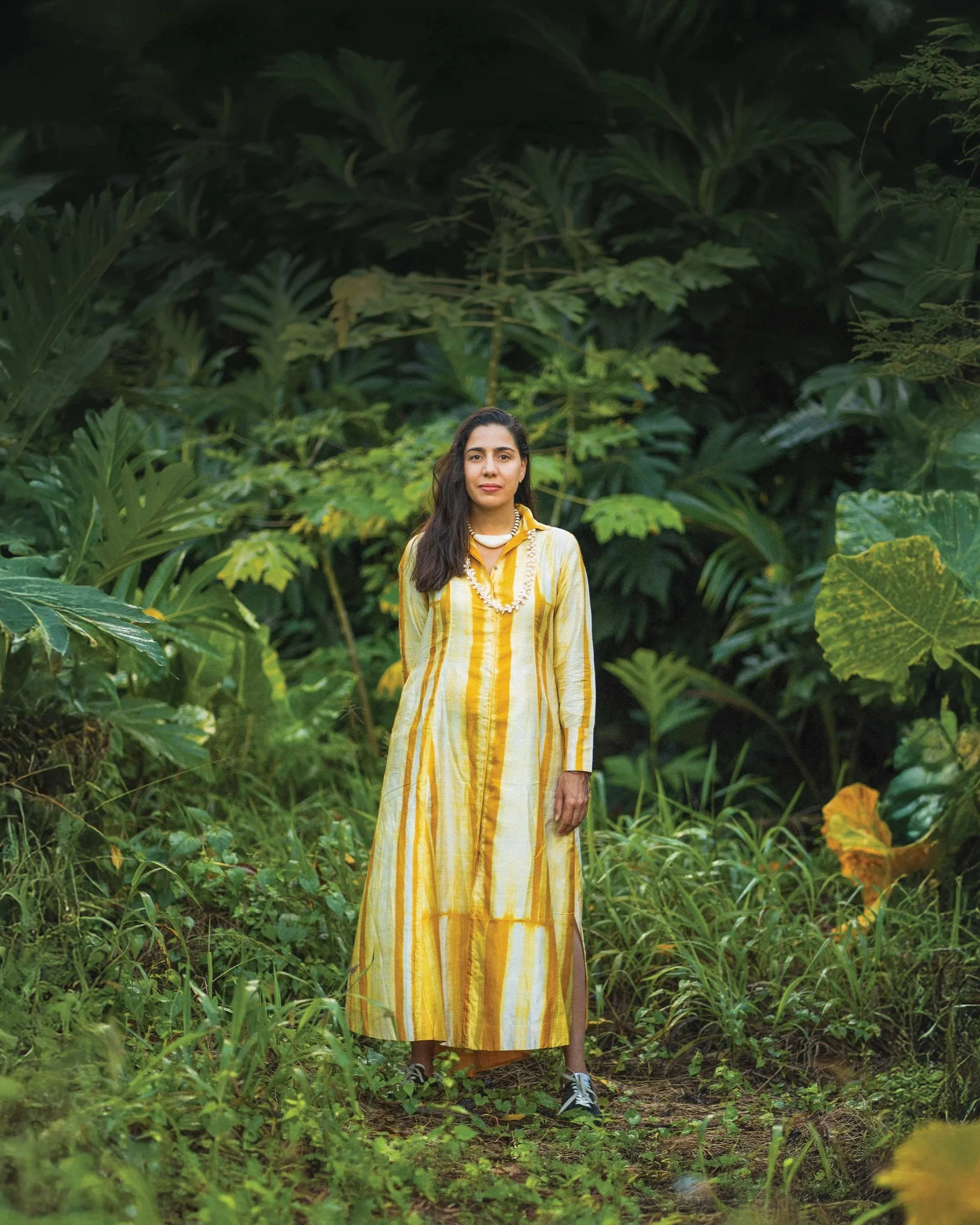
In Hawai‘i, Diana Campbell has found the boundaries between art and everyday life are less fixed.
(Photo courtesy Luke Scott Fernandez.)
Diana Campbell doesn’t remember a time when she wasn’t surrounded by art.
Raised in Los Angeles, with frequent trips to Guam to visit her grandparents, Campbell recalls going to museums and seeing intricate Pacific objects behind glass. She would ask her parents: Why couldn’t they have similar things in their home or in her grandparents’ house?
“My mom’s answer was that Guam was in the tropics, where it’s humid, there’s bugs. Her and my Aunt Carmen lived through terrible typhoons,” Campbell says. “It’s not a place for paper.” Objects, in other words, were not built to last.
“The treasure is not the thing itself. It is the knowledge of how to make something. And the minute that goes away, then the treasure is gone.”
This idea continues to shape Campbell’s approach today as a curator working across disciplines and geographies, engaging as closely with artists’ processes as with art itself. She’s less interested in static finished pieces than in process and collaboration. Campbell is drawn to “making knowledge,” the sort of embodied (and often unrecorded) intelligence that doesn’t always sit neatly within institutional hierarchies.
“Part of contemporary art is that it has to be connected to life. It’s about how artists are synthesizing the times that we live in,” she says. “I’m interested in working with people who are always imagining something new and thinking from different perspectives, rather than a fixed way of looking at something.”
Campbell’s openness to process and to ways of knowing that resist easy categorization is a reflection of her own experience moving between cultures. As someone who grew up navigating different worlds, from visits to her grandparents in Guam to studying ballet in Los Angeles to graduating from Princeton, Campbell has come to see in-betweenness less as a limitation and more as a curatorial instinct.
In 2010, she moved to India and found herself learning the country through studio visits and informal artist networks. “The curatorial scene there was quite nascent at that time,” says Campbell. “Basically, we had to kind of create the institutional infrastructure to enable the different projects we wanted to do.”
Campbell began organizing residency exchanges for Indian artists. She connected them with opportunities abroad while trying to understand what was missing locally. Around the same time, Campbell received funding to study sculpture parks around the world. “There weren’t really sculpture parks in India. Artists weren’t making that kind of work because there’s no storage and no production facilities.” Structural issues, like transportation, limited what artists might build.
Instead of being limited by these constraints, Campbell began to work through them. During this time, she met Nadia and Rajeeb Samdani, a young Bangladeshi couple with a similar structural ambition. As they traveled internationally, they found themselves repeatedly confronted with a narrow perspective of their home country.
“The only thing people had to say about Bangladesh was that it was a poor country, that there were collapsing factories and that there were floods,” Campbell says. “They didn’t know about the exceptional architecture, amazing textiles, art, culture, history… Bengal was one of the richest civilizations of all time.”
Together, they launched the Dhaka Art Summit in 2012 as a noncommercial platform for exhibitions, public programming, and research centered on South Asia. Organized by the Samdani Art Foundation in collaboration with the Bangladeshi Ministry of Cultural Affairs, the summit would take place every two years in Dhaka, free and open to the public. It quickly scaled into one of the most significant recurring art events in the region, drawing hundreds of thousands of visitors.
“We didn’t expect it to become such a big success,” says Campbell, who became chief curator of the summit. “Nadia and I were in our twenties, Rajeeb was in his 30s… There was a lot of youthful [folly] that went along with it. In a good way.”
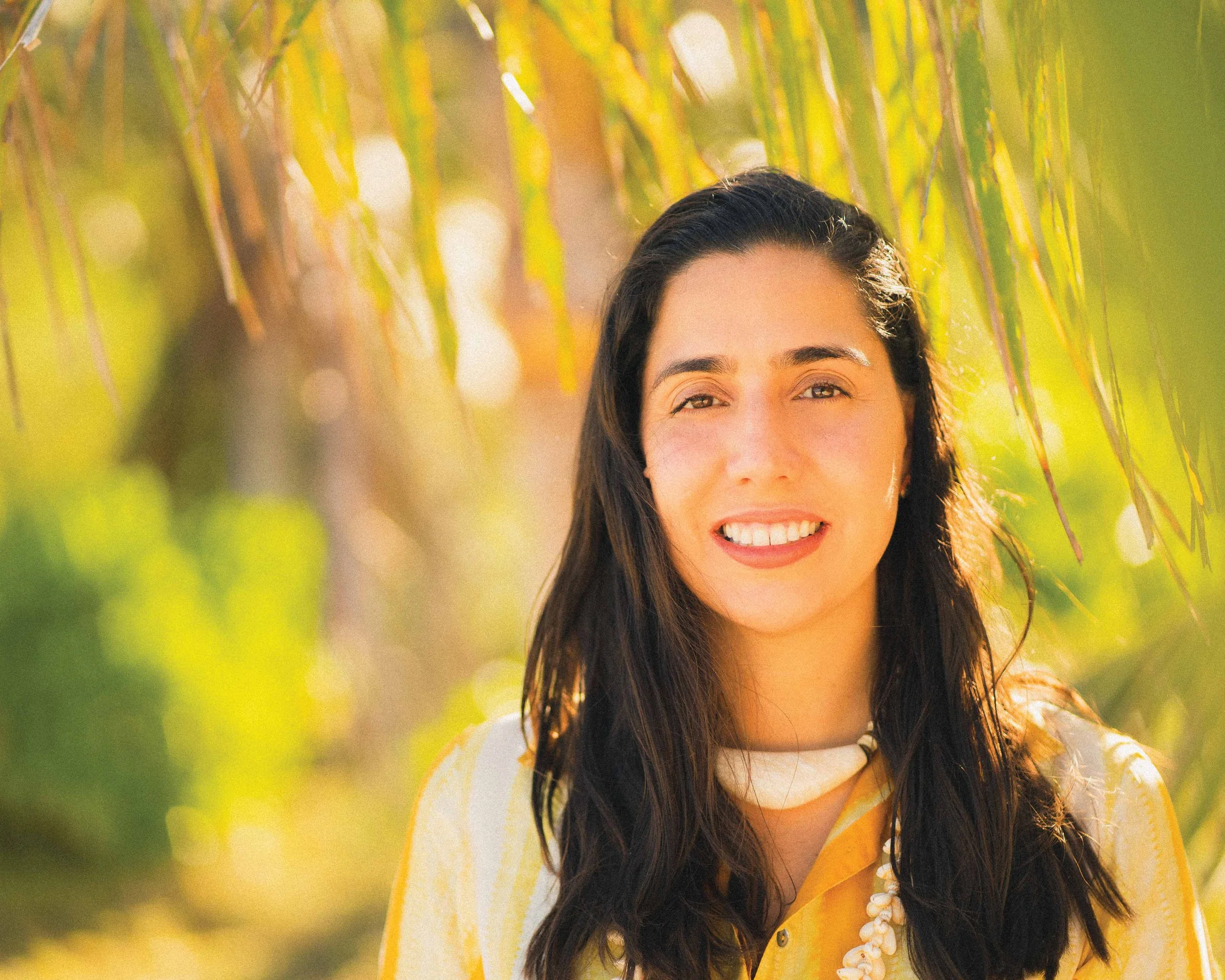
Campbell’s curatorial work bridges communities together. She is grounded by a lifelong connection to Hawai‘i .
(Photo courtesy Luke Scott Fernandez.)
Dhaka Art Summit became an early springboard for artists to gain international visibility and reach wider audiences. One such artist is Joydeb Roaja, a Bangladeshi artist who grew up in the Chittagong Hill Tracts, a mountainous region marked by military presence and long-standing tensions over land and identity. Roaja often depicts Indigenous figures as large and commanding while military forms appear small and toy-like, resulting in an inversion of scale that reshapes ideas of power. Roaja’s art pieces frequently move between image and performance, with bodies carrying symbolic props like cardboard tanks; his work has since been shown at institutions including the Metropolitan Museum of Art and Tate Modern.
“[Roaja] is trying to rescale that relationship between Indigenous people and occupiers through his art,” Campbell says. “At a recent [Dhaka Art Summit], we translated that into an installation of figures lifting a submerged palace from the water. It’s a real story: the palace of the Chakma king is under a lake because construction of the Kaptai hydroelectric dam flooded the region.”
Campbell is aware that when art pushes too directly, especially around politics or power, it risks being shut down. Some of the most pointed works at Dhaka Art Summit are disarming, even playful. One installation by Afrah Shafiq with Jeremy Waterfield took the form of a video game housed inside a towering, pixelated anthill. Visitors stepped inside and played, making decisions that shaped the fate of a colony.
“It looks fun,” Campbell says. But the game’s Bangla audio told another story, featuring fragments of real conversations with young people. They shared concerns such as “I’m afraid my mom won’t come back at night.”
“It was a commentary on the fear that people were feeling,” says Campbell, pointing to the political unrest that would culminate in the ousting of a dictator in 2024. (The art piece, Rotational Rider: Where Do the Ants Go?, was shown more than a year earlier.) “[Rotational Rider] was in a different language, coded in a way that was a video game. You needed to have a certain set of eyes to this.”
What you see depends on where you’re standing. In Hawai‘i, Campbell has found the boundaries between art and everyday life are less fixed. At the most recent Festival of Pacific Arts and Culture (FestPAC), held in Hawai‘i in 2024, she watched as communities danced, performed, and carried paintings outdoors. Art unfolded in real time rather than behind glass. On another recent trip, she gave a lecture in a museum studies class at the University of Hawai‘i and spent time with curators from the Honolulu Triennial, whose work is similarly invested in cross-Pacific exchange. “I have family here, so we would come to Hawai‘i to visit. A lot of my childhood memories—of becoming a person—are here.”
“I want to take on projects that allow me to engage with oceanic art and create similar kinds of opportunities that I did in Central and South Asia,” Campbell says. “It doesn’t mean moving objects all over the world and putting them in air-conditioned white rooms.”