
The Visual Architect
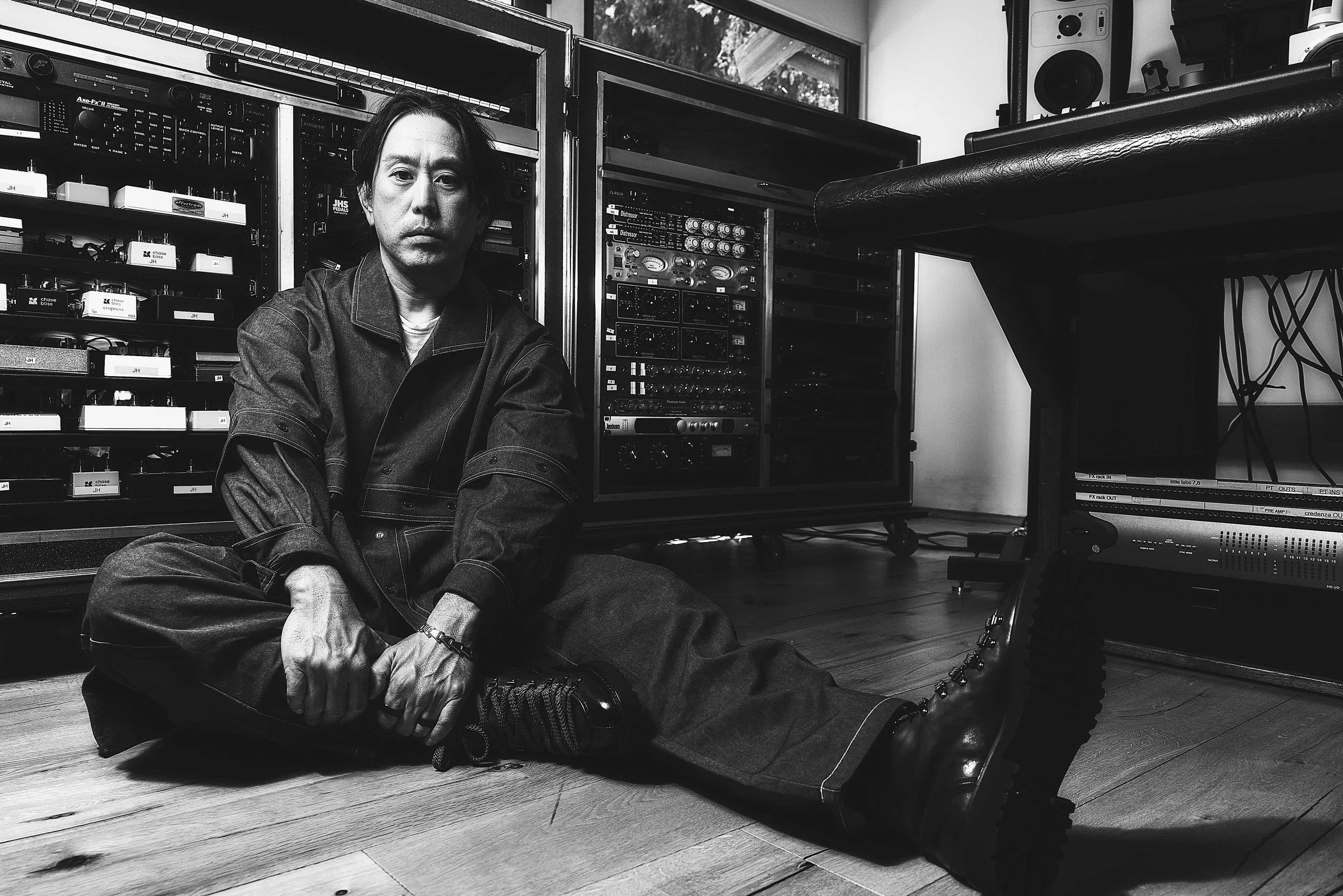
IOEDLE jacket and trousers; DOUCAL’S footwear; PIANEGONDA bracelet.
photos FRANK MADDOCKS V @frankmaddocksv | @fm.tiff
digitech / lighting tech NATHANIEL CERVANTES @wet_negatives
creative director FRANK MADDOCKS
stylist MEESH DARANYI @designxmeesh
grooming JENNIFER DARANYI @jdmakeup
It’s a Monday night in Hamburg and Linkin Park takes the stage.
This is the band’s first show of June, the final month of their nearly two-year From Zero world tour. The first without lead vocalist Chester Bennington, without drummer and co-founder Rob Bourdon (who departed the band), and co-founder and lead guitarist Brad Delson (who stepped back from touring).
It’s also been nearly two years since Emily Armstrong made her debut as co-vocalist alongside Mike Shinoda. More than 25 years since the band itself became a worldwide phenomenon, thanks to hits including In the End, Numb, Faint, What I’ve Done, and countless other tracks that have since dominated rock airwaves. In the post-grunge and nu metal surge of the early 2000s, Linkin Park stood apart from a crowded field with a sound that fused blistering guitar riffs with hip-hop beats, bit-crushing synths, and surprising emotional depth.
There’s a lot of history onstage tonight at Volksparkstadion. Not to mention a lot of people; this sold-out stadium is filled with upwards of 67,000 fans, many of whom are now chanting.
Linkin Park! Linkin Park! Linkin Park!
“You ready to sing?” Shinoda asks the crowd as Crawling rises out of the speakers.
At the turntables: Joe Hahn. As the band’s DJ, he’s been responsible for some of Linkin Park’s most famous synths — think the intro/outro scratching of With You and Wretches and Kings, or the heavily sampled Cure for the Itch (“All right now, wasn’t that fun?”).
Offstage, Hahn’s role goes beyond sampling and programming. He is Linkin Park’s creative director too, helping oversee album artwork and merchandising, directing most of their music videos, and designing much of the band’s visual language. Everything from the stenciled soldier with dragonfly wings of Hybrid Theory to the abstract light-and-dark pattern (a nuclear explosion or a bird in flight?) of A Thousand Suns.
“I see all of these roles as ways to be creative and to be collaborative. As a musician, I can create and combine sounds in a myriad of ways that lead to an emotional response,” Hahn says, responding between shows in Spain, Italy, and Belgium.
“As a visual artist, filmmaker, or performer, it all boils down to obsessing over ideas. … Storytelling is a big part of it. Some of it is what you say. And a lot of it is what you don’t say, leaving the audience filling in the blanks for themselves.”

Linkin Park performing two sold-out shows at the Allianz Arena in Munich, Germany in June.
(Photo courtesy Ben Houdijk.)

(Photo courtesy Chady Awad.)
Before ideas, Hahn was obsessed with music growing up. At first it was piano. Then he studied violin and guitar in high school before becoming interested in hip hop and turntables. While studying illustration at the ArtCenter College of Design in Pasadena, Hahn met Shinoda, who invited him to join his band Xero, which included Shinoda’s childhood friends Delson, Bourdon, and bassist Dave Farrell.
“We wanted to do something melodic and heavy that had hip-hop in it,” Hahn said in a 2005 interview with Yamaha. “But that music didn’t exist, so we got together and made it. The core idea is to combine those sounds, plus things drawn from electronic and classical music.”
What emerged was a sound that didn’t easily fit into any category, and was intimidating to record executives unsure how to market it. More than 40 rejections from record labels would follow before Warner Bros. Records signed the group in 1999.
Meanwhile, the band’s identity was still evolving. Xero briefly became Hybrid Theory (until discovering another group already using Hybrid), then became Lincoln Park as a nod to the park in Santa Monica… except “lincolnpark.com” was already taken. Changing the spelling solved the problem, and Linkin Park was born.
A breakthrough record deal — and ultimately more than 100 million records sold, two GRAMMY wins, and having their first three albums reach a combined 25-times platinum — is the kind of success most musicians dream about. Linkin Park explored themes that were still uncommon in hard rock, such as anxiety, depression, and addiction. Songs like Breaking the Habit and Somewhere I Belong brought mental health into popular music in a way that resonated with millions of listeners.
For Hahn, who is Korean-American, the band’s rise also meant achieving success at a time when Asian Americans were rare in mainstream U.S. bands. Alongside Shinoda, who is Japanese-American, Linkin Park became something that people hadn’t seen before.
“When we started the band, I wasn’t thinking about representation at all. I was more concerned about just being able to survive and continue this,” says Hahn. “However, it’s something that I have reflected on … I’ve had younger people let me know that what I do has been encouraging to them to have courage despite the odds against them.”
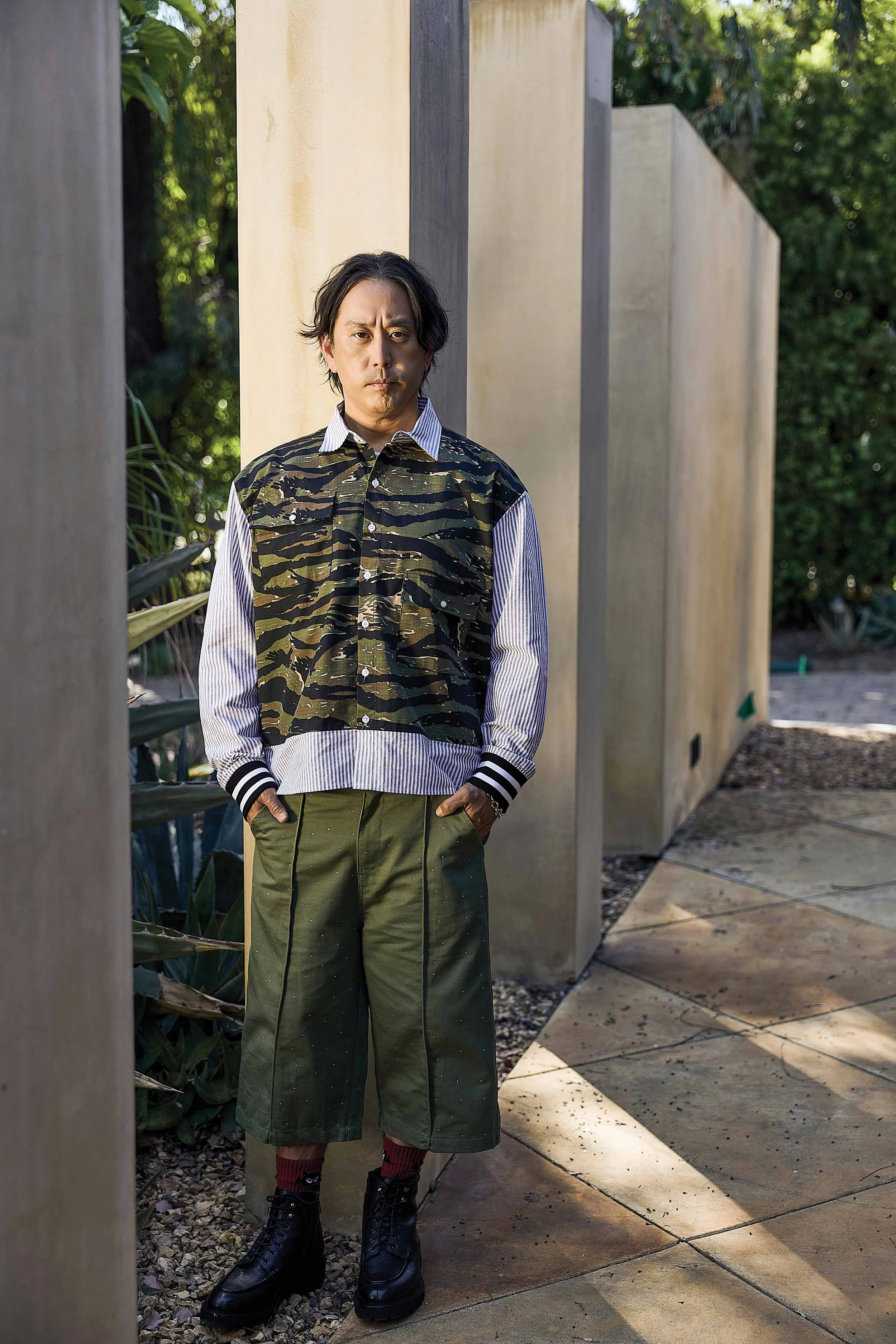
AKOMI long-sleeve shirt and shorts; DOUCAL’S footwear; PIANEGONDA bracelet.
(Photo by Frank Maddocks V.)
Over time, Hahn’s perspective changed. He spent many years in Hawai‘i “because my wife and I wanted our daughter to run in the grass barefoot and not feel alienated,” Hahn says.
“I’ve had so much kindness thrown my way through people opening their arms and their homes. There is a spiritual connection through the land and sea that grounds everyone.”
While in the Islands, creative opportunities followed. For the 2010 reboot of Hawai‘i Five-0, Hahn was approached by pilot director Len Wiseman, known for Underworld, Live Free or Die Hard, and last year’s John Wick spinoff Ballerina, to create a new version of the show’s iconic theme song. His was a synth rock interpretation of the original “until the stuffy suits over there said [they] thought that it wasn’t good,” Hahn later wrote on his website, and the series ultimately went with an updated version of the classic theme instead.
In 2019, he contributed a mural in Kaka‘ako as part of World Wide Walls (formerly POW! WOW! Hawai‘i), painting a split-face mashup of Spider-Man and Captain America. “This is my #Marvel #mashup for all the #keiki to enjoy,” Hahn shared on Instagram. A year later, he returned with a grinning green Hulk face (“my attempt to smash a wall”) to commemorate the street art festival’s 10-year anniversary in early 2020. Public art became another outlet for the artist.
After the pandemic, Hahn returned again with the mural, A New Way, A New Way: three overlapping faces sharing two sets of eyes, looking out over an H-1 embankment in Kalihi, painted with the help of local kids.
“There is nothing but great Aloha and smiles in Kalihi,” Hahn shared in 2023. “At the opening, [artist Kaplan Bunce] gave a blessing and said ‘…Art can change the world’. That is the truth.”
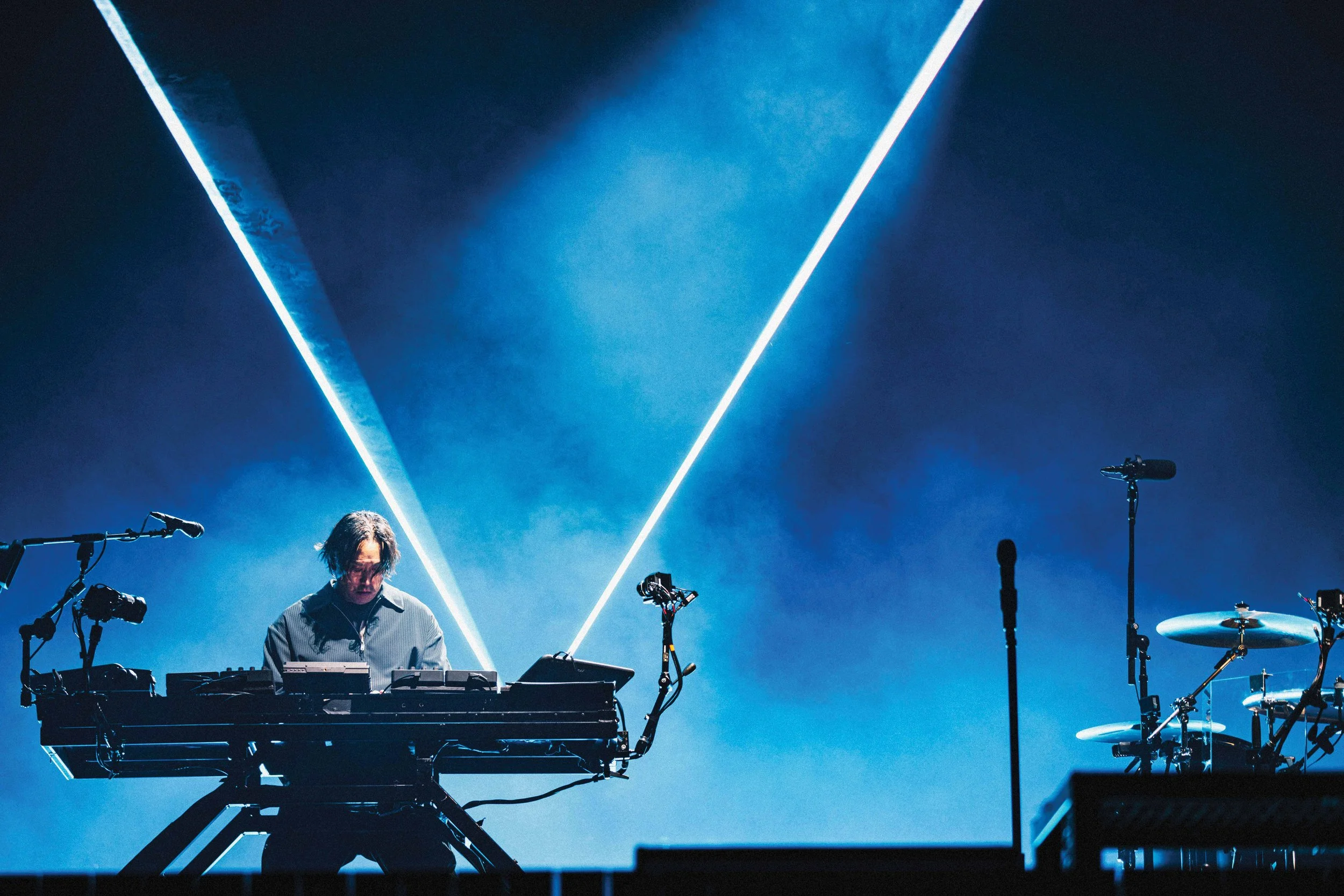
Joe Hahn on stage in Vienna for Linkin Park’s From Zero world tour in June.
(Photo courtesy Chady Awad.)
Hahn’s instincts for visual storytelling are at the heart of his biggest filmmaking project yet: Unshatter, a Linkin Park concert documentary due this fall. The movie draws on years of footage spanning studio sessions and interviews with band members as it traces the period following the death of Chester Bennington in 2017.
“We had an opportunity to film our concert in São Paulo on the day our album, From Zero, was released, November 15, 2024,” says Hahn. “This whole thing became about hope, fighting to make something that isn’t meant to be. It is also about honoring each other and doing the right thing. … Unshatter was an opportunity to show what this is about and not just tell what it is about.”
The film also documents Linkin Park’s creative rebuilding, including the arrival of new collaborators Colin Brittain and Emily Armstrong, before their return to the stage in 2024 with From Zero.
“We put out a record today, it’s out in the world,” Shinoda tells his bandmates in Unshatter. “This show is everything we worked so hard for. I can’t believe we’re here.”
Unshatter captures the epic scale of Linkin Park, though Hahn describes something smaller at the band’s center: the way the group works when it’s just the six of them in a room.
“Oftentimes, when we get together to make music, we talk about life. Our conversations range from joy, frustration, and sadness together,” Hahn says. “I know that some could see me as ‘weird’ or ‘different’. With my friends, they just see me as Joe. … We amplify each other. That is what makes this band unique. I don’t know how other bands do it, but this is how it works with us.”
“My joy is … a stadium full of smiles jumping up and down to my music around the world with my friends.”
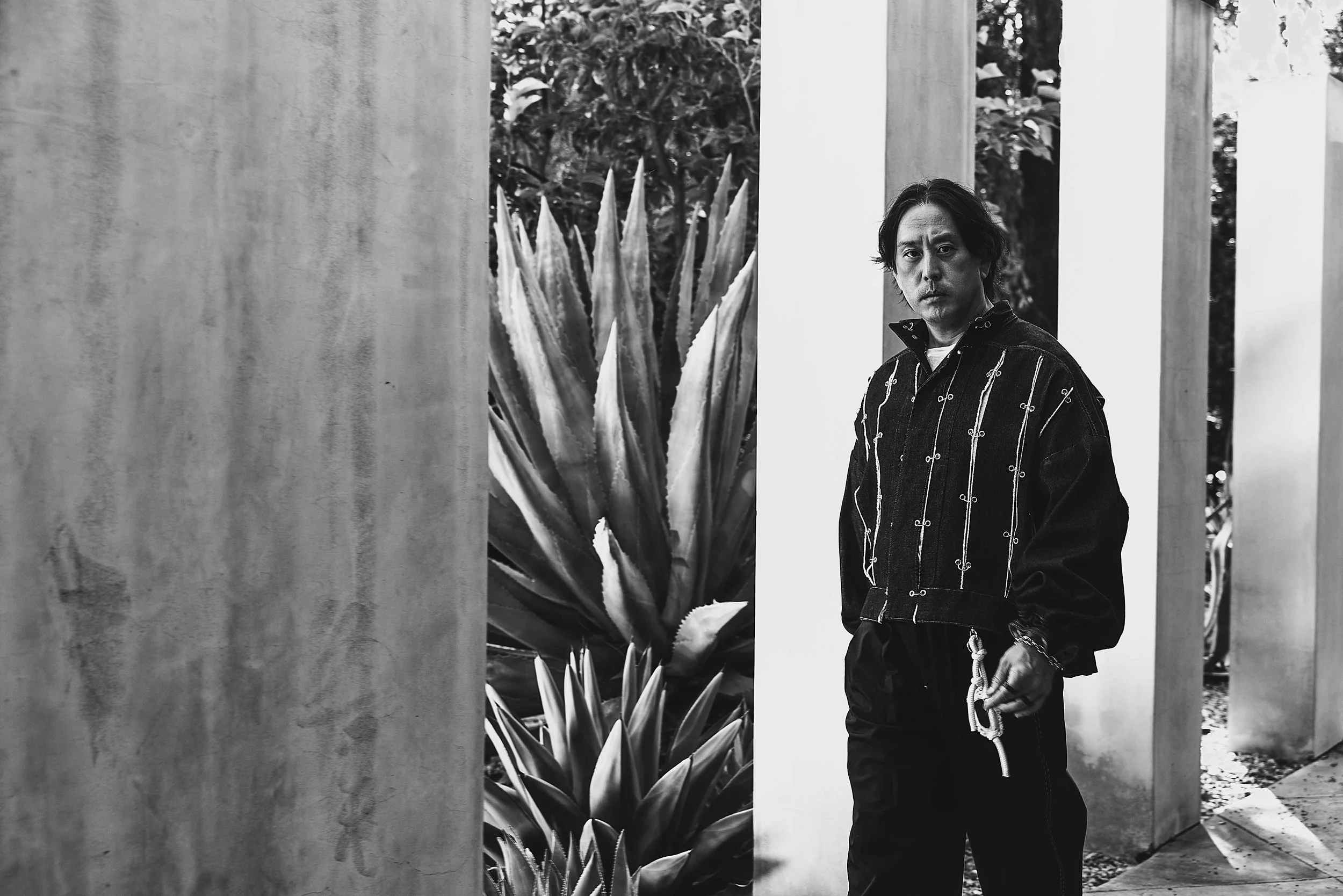
THEO jacket, INTODUSK trousers, AKOMI footwear, PIANEGONDA bracelet, SONG FOR THE MUTE accessory.
(Photo by Frank Maddocks V.)